I felt the stares of the people I was with at the bar.
“I just haven’t seen anyone order Budweiser in ages. Or maybe ever.”
Said the friend who has returned to being a stranger to me again.
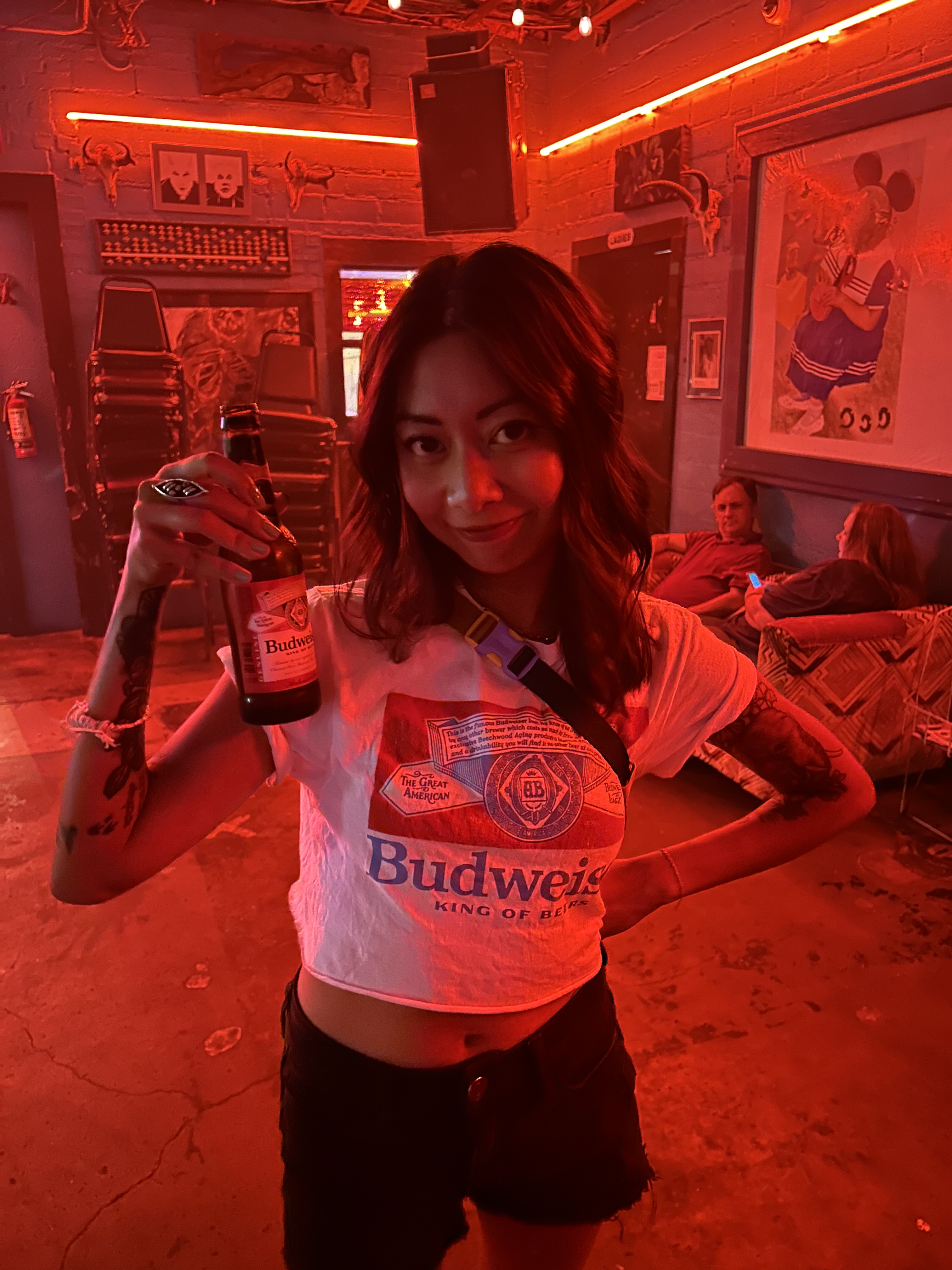
“I thought this classic beer would do for tonight.”
I didn’t need to tell him he didn’t have to know that when I drink Budweiser I see a photograph of a stone, park table a few cans of Budweiser vintage now the sun, high, illuminating healthy, old trees in the foreground my father in a white tee and denim button down grinning happy his arm slung around his best friend
I didn’t need to tell him he didn’t have to know that when I drink Budweiser I feel the brisk evening air coming off the lake as I watch Grampy at his 70th birthday party in his chair at the table on the patio with Nana nearby remembering their ritual of cracking open their first evening beer together and toasting to each other before taking a sip
“I will never be like him,” she laughs, as he recalls a childhood memory of his, the time he almost swallowed and choked on a whole baby mango because he didn’t want to share it with his siblings. He seems energetic and happy at the wobbly dinner table, surrounded by mismatched chairs. When he’s done eating, he leaves the table abruptly to smoke a cigarette outside and commands the family to clean up. She sweeps the floors, the easiest task for the youngest. Her brother puts away the leftover tum makhoong that Pa had made and the rest of the khao niew, still half full in the woven rice baskets.
“I will never be like him,” she ponders admiringly, as he builds a shed in the corner of the backyard to store gathered scrap wood, tools, and spare knick knacks that the house can’t hold. “Jao het heuan hai mah, boh? Are you building this house for our dogs?” she asks innocently, 6 years old, hoping that that’s the case. He doesn’t respond. “I guess he thinks that’s a dumb question,” she thinks, as she walks away to play in the herb garden that he’d grown, searching for snails to bother.
“I will never be like him,” she mopes, as she watches him sitting stone silent, staring at the rain pounding against the truck windows, immobile, stuck, hungry, as she waits to gather her school things and to go inside the house. “Pa,” she murmurs. It had been a long day for a second grader. He makes her wait in the truck with him until the rain subsides. They don’t speak.
“I will never be like him,” she tells herself, over and over, tears streaming heavily and quickly down her face as she watches her mother put the household back together after another of her father’s rage episodes. She helps take the belongings that aren’t broken out of the trash and takes them to the kitchen sink. Her mother moves just as slowly and deliberately as he had moved so rapidly and destructively. She hears him crack open a Budweiser in the next room over.
“I will never be like him,” she screams internally, watching, helpless, as yet again, another of her siblings takes a whipping for his irrational “reasons.” This time, she throws herself across her sister’s back in the hopes that he won’t strike his smallest, youngest child. She is wrong.
“I will never be like him,” she walks away reluctantly but still without hugging him goodbye, as he remains seated in the living room of his care facility. He wears a scarf around his neck, gifted to him by her loving brother, taken off of his own neck just moments before. Pa said he was often too cold inside the building. She vows to return, to interview him and ask him the questions he has promised to answer, to write his story, the family’s story, but she never gets the chance. “Bye, Pa.”
“I will never be like him,” she declares, out of the corner of her mouth, lighting a cigarette, drinking a Budweiser, sitting on the tailgate of her truck. She waits.
It was easy to spot him in a sea of people. He was wearing a black cowboy hat and boots, having fallen in love with Texas fashion upon arriving from Laos in ‘89. I thought he looked a little silly but loved him for it, even as a teenager who deeply cared about appearances. Pa walked up to me with flowers in hand, grinning from ear to ear. The lilies were a little expensive, but they reminded us both of plumeria, in fragrance at least, which grew abundantly in his hometown in Laos. He presented them to me and then pulled me into a hug. I could tell that he was radiating pride for his youngest daughter graduating from high school, and, at that moment, I was proud to be his daughter too.
My high school was quite small – a graduating class of 58. It was tradition that the graduation ceremony was held at a historic church in downtown Dallas. The stained glass windows cast warm shades of red and yellow along the hall where families were gathering. It was the perfect golden hour on a Friday evening: laughter, chatter, and hugs all around. Young adults on the verge of the next big step of their lives. This moment in time was a milestone for both of us. Pa was a man of few words, but he really didn’t have to say much. We understood each other.
—
This time, there were more people. I graduated with an Integrative Studies degree from the University of North Texas, and the ceremony was in the coliseum, and the crowds were dense after the graduates were all released to find their loved ones. Flowers in hand, again, Pa was waiting by the steps, a strategic place for me to find him. Smart, I thought. I wondered if always finding a good lookout point was an instinct leftover from having fought in the Secret War. He was a clever, resourceful man, always creating.
It was a warm day in May and the sun was high. I couldn’t wait to eat at the Thai restaurant in town that had the savory and funky flavors in their dishes that were closest and most pleasing to our Lao palates. I was impatient when I was hungry, much like Pa. We waited for the rest of the family to find us. This graduation was enough for me; I opted not to attend the ceremonies for my master’s degrees. Achieving an undergraduate degree was the highest education anyone in my family had earned at that point, and I knew, again, the amount of pride my father held for me then.
—
And then Pa was tying white threads around my wrist at my wedding reception. I shed a tear as he wished for my health and prosperity in Lao. He said that Mae had been up so early that morning, preparing the threads, the boiled eggs, and the steamed rice desserts for the ceremony. Pa had a tenderness in his eyes when he spoke of her.. He complimented the blending of Lao and Texan traditions, grinning at the cowboy hats that several of the wedding party had donned on their way in. He loved my partner as his newest, youngest son.
We whispered inside jokes and teased one another on the dance floor, relishing in a moment together and chuckling to get through our nerves. He twirled me a few times to an old country song, but we’d established during the wedding planning that he was too shy to dance for a whole song. So off we went to raucous applause at the end of our very short father-daughter dance. It was bliss.
—
Across the pha khao from me, Pa is cradling a Budweiser can in his left hand as he eats khao poon with chopsticks in his right. I’m annoyed at the slurping noises of approval at my cooking but also so happy to see him enjoying the food I prepared. It’s our favorite Lao meal: red curry and coconut milk soup with somen noodles, spicy, just a hit of sour, fresh, and so texturally fun to eat. “Saap e-lee,” he tells me, grinning and nodding. “Thanks, Pa,” I respond, laughing as he abandons his beer to lift his bowl and drink every last drop of soup.
—
If only these scenes were real memories. If only Pa were still alive. I would tell him how much it would have meant to me to have tried to heal our relationship, so that I could share with him about those milestone life events from which he was absent (I wasn’t ready to invite him). Though I’ve imagined these scenes from the perspective of “wishing my father had been the kind of loving, caring, delightful, compassionate father that everyone deserves,” I am also writing it from the perspective of “this is who I wish I had been too.” We are both not without our flaws.
I would apologize for subconsciously punishing him by avoiding and excluding him, and that my anger at his mistreatment of me, of his own family, felt justified. So I never called. I never considered inviting him. In my distance and protecting my peace and happiness, I was safe. It turns out, I was still afraid of him, despite his aged and frail body, he was still the monster my younger self saw. Feeling righteous and powerful, I was adamant that my abuser would not be allowed in my presence. Power can delude you, too.
And trauma can cause you to make decisions you might deeply regret with perspective but it is part of the healing process and cannot be discounted. You have to be gentle for treating people how they time and time again proved that they needed to be treated to protect yourself. For making choices that you wish you could change (but would you?). I don’t remember the last time that I hugged my father. (But why would you hug your abuser?) It goes on.
Grief has twisted its tendrils around every bit of me, sometimes binding me so tightly, I am incapacitated.
Perhaps, reader, you have gathered that I did not invite him to either graduation, nor to my wedding. We also never shared moments like eating a meal that I had made together, and it pains me that he never got to try (and criticize but maybe lovingly) the Lao food that I make these days with pride.
My father had crippling PTSD that went untreated, and his actions my entire life necessitated distance from him. I thought I might be able to log an interview or two with him after some years of my own personal work in therapy, but COVID took him from this plane of existence and that was that. I thought I had time, and that is a misconception that we all make and must forgive ourselves for. I am here, fatherless, and without ever having the chance to invite him to any other milestone events again, even if I chose. Even if it were a possibility. And I live with this. It doesn’t get easier; but we get stronger.
I’ve loved khao poon for as long as I can remember. Khao poon is the shortened title I’ve given to one of my favorite Lao meals: it’s a red curry and coconut milk based soup that is served with rice vermicelli or somen noodles and an abundant selection of fresh vegetable and herb toppings to customize one’s bowl. The soup broth is flavored by the red curry, punched up by fresh ginger and garlic sauteed before combining with the curry and coconut milk.
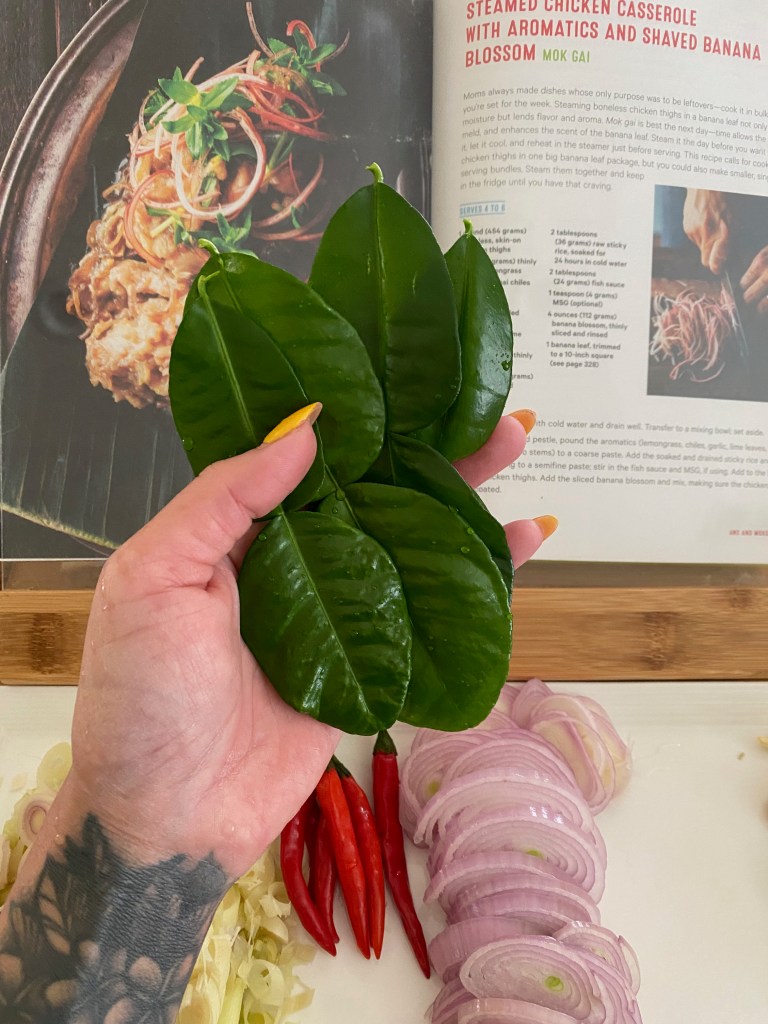
What distinguishes this soup broth from all the rest is the makrut lime leaves that simmer in the broth; without them, it’s just a red curry coconut milk soup but with them, it’s khao poon. The lime leaves impart a delicate perfume to the broth and flavor it with a depth of citrus. If absent, you will notice.
Makrut lime leaves have to be carefully plucked from the tree. There’s a small thorn between the leaf and the stem that will prick you something fierce if you’re not mindful of it. Nature has a way of preserving itself, as do we humans. You have to accept the entire tree, thorns and all. Wishing for a different existence for the tree does you no good, and without its thorns, it simply wouldn’t be a makrut lime tree. Through honoring and understanding the ingredients with which I cook, I’ve learned a lot in addition to knowing about the essential components of a complex broth – I’ve learned a lot about people. There’s a lot of time to think when you’re in the kitchen, preparing dozens of servings (which requires a lot of repetitive movement and a lot of time). I wasn’t in a place to make khao poon, or any Lao food for that matter, for my father before his passing, and I’ve only just begun to accept the thorns with which he existed. He had a temper that would turn into rage. His complex PTSD rendered it impossible to coexist in a home with him peacefully, and so we never got to know one another. Wishing for a different way of his being and our relationship has done me no good, so I’ve embarked upon a journey of understanding and forgiveness. Much of this is accomplished in the kitchen. Some of it is accomplished while keeping my makrut lime tree alive.
Of all the meals that I would come home to at 10 PM after a long day at school and then at my cashier job at a local grocery store, khao poon was my favorite. I would be delighted if there was a pot of khao poon broth on the stove and the noodles and toppings left out on the dining table for me. My mother was usually already asleep, but still just awake enough to know that I’d arrived safely before falling into a deeper slumber.
Khao poon was an “I love you, please eat, and good night” between she and I – when it was just the two of us remaining in our family home in Dallas for some time. In college, I would crave khao poon and try to replicate this meal with the red curry I would find on the shelves at Sack and Save behind my dorm building. To no avail. I mean no offense to the Thai Kitchen brand, and I have often found myself grateful for it when needing particular sauces or ingredients in a pinch, but it just didn’t cut it for me. For one, the curry lacked key ingredients that would only be found in a specific brand that my mother used, and secondly, food tastes different when your mother prepares it for you.
8 years post-early college days, in January 2019, I’d find myself making a giant batch of khao poon for a dinner party of twenty guests. At this point, I still hadn’t learned to simplify and focus on making *one* signature dish for this kind of event. I was scrambling the morning of dinner party day, even with the help of my partner, to get everything done.
It seemed like the water for the noodles took triple the time to boil, and the coconut milk I’d chosen did not want to reduce down to the creamy-almost-oil that is important to the flavor of the soup broth for the life of me. At the end of the night, loading equipment, pots and pans, and food containers back into the car, I realized.
I’d forgotten the critical ingredient: the makrut lime leaves. None of the guests, aside from the close friends who were there that I’d confided in, knew of my error. But I was deeply ashamed. January 2019, it occurs to me now, was also the last time that I saw my father in-person, about a week after the dinner party in which I had forgotten the most essential ingredient.
This past December (2023), I’m counting makrut lime leaves like they’re cash – 32 leaves for 8 gallons of liquid, with about a dozen fresh leaves and a package of dried ones in hand just in case the broth needed adjusting during service at our first pop-up market in over a year.
I’d launched Good & Golden, my Lao food and culture business, in December of 2021 and had learned a lot from the events we’d hosted and services we’d started to offer.
We served khao poon to guests at True Leaf Studio’s night market and sold out within a couple of hours. Our return after a year away felt triumphant.
In the stillness after the chaos of prepping for, working an event, and serving Lao food to friends and strangers alike, I pause to reflect and practice gratitude for the woman who taught me to make khao poon and where I came from. And though prickly and sometimes a pain (and often the one who inflicted it), I can’t neglect to honor my father and what he has passed on to me as well, no matter our complex relationship. Or maybe, in spite of it.
where to find the essential leaves
Although Denton appears to have a couple more specialty food stores opening up (Bhavya, Basmati Grocer’s), I’ve found that you have to drive either to Carrollton or to Haltom City to find fresh makrut lime leaves that make khao poon so special.
You are able to order dried makrut lime leaves online, but in this case, I do like to stick to the phrase, “fresh is best.” It’s worth it.
If you’re very ambitious and can plan to be there during New Year’s festival weekend, you can purchase a makrut lime tree from the farmers who set up as vendors at the temple for Lao New Year. Then you’ll have fresh lime leaves at your disposal. Mind the thorns.
There was a pot of soup bones on the floor, oxtail and chicken neck, underneath the archway that divided the dining area of our kitchen space from the cooking area. I wondered if Pa was angry that the kitchen was in disarray, so I blamed that pot of bones, averting my eyes from the scene unfolding as he stood at the dinner table where we’d all just had a normal, almost pleasant even, meal together. Most dinners included sticky rice and papaya salad and stories about Laos or old friends in youth and their antics; Pa was always the storyteller, and he was good at taking you on a journey and making you laugh along with him. But tonight, Pa was yelling, which meant that we all had to stay frozen in place until he was done. It felt like days would pass before his rage-rant would end.
I was 10 years old and maybe all of four feet tall, so small in frame that people would gawk, too melancholy for my age, and always cold. I wasn’t starved of sustenance, just of warmth from love and the freedom to express it. I didn’t dare look at Mae’s or my siblings’ faces. Mae had instilled in me belief in the universe’s magic and power and belief in the old world and motherland superstitions from as soon as I could understand stories, and I had developed some of my own. Sometimes they made more sense than the world I inhabited. If I stood as still as possible, back then, I believed and desperately hoped that magic would be activated and I could become invisible or quite possibly disappear into thin air, becoming space dust, becoming a part of the universe that was untouchable but ever present.
But the world I lived in was all too real in that moment, stuck in my earthly vessel, no way to disintegrate. Tuning back in, I worried: What was he talking about? Why was he yelling that no one respected his wishes? That none of us loved him? That his daughters were disobedient? What did my sister’s car being parked on the street in front of the house have to do with anything? Why would Pa threaten to line us all up and shoot us before killing himself? Except in my memory, this was a scene that repeated itself fairly regularly. I wondered why I still wondered. I still do.
Somehow, part one of the “episode” (as I call them) ended. We were ordered to complete our post-dinner tasks: the youngest, me, swept the floor after dinner. My sisters cleared the table and washed the dishes. Mae put away leftover food. She threw away the bones. My brother pushed in the mismatched chairs, picked off of curbs just like the table was, and wiped all of the surfaces clean.
Pa had his own task after dinner that night: he loaded the shotgun that he kept in the old wooden dresser that we used as a TV stand in the living room. It was quiet in the house. No talk or chatter.
The eeriness that came between scenes during these episodes descended upon the house, and Mae ushered me out the back door and told me to hide in the family suburban. She assured me that she would get everyone else out of the house as quickly possible. We were building the plane as we flew, cobbling together our escape plan as quietly and quickly as we could.
I hid behind the front seat rather than sitting in the open, trembling with the terror of being caught attempting to leave. Moments or perhaps an hour later, Mae came to get me out of the car, and walked slowly behind me to the back door of the house. It felt like a death march. My feet were heavy. Pa was waiting.
“Do you want to die?” he asked his youngest daughter. I was frozen. I felt my mother, distant but near, behind me. She must have been watching him with despair darkening her eyes. My eyes.
“No,” I murmured, shivering, jacket-less, a forgotten article of clothing as I’d hidden in haste, standing on the bottom step of the three that would lead inside the place where I just might become space dust that dreadful December night. Looking down the barrel of a shotgun and at my father, I wondered again, if the pot of bones had been the catalyst for this episode. But Mae had thrown them out and that didn’t reset the course of the evening or fix anything. I was disappointed in the lack of magic in this world. I knew he could pull the trigger and blast me into oblivion. Maybe oblivion was the magic. Maybe my mother would go with me.
Wordlessly, Pa directed us inside by pointing the shotgun barrel towards the dinner table, stepping aside. I don’t remember if I ran or not. But I remember finding and hugging my brother for what felt like the first and last time in the middle room that served as a bedroom for most of us. We were common sibling enemies, but in that moment, I felt like he might be able to protect me, and truly wanted to. We transformed into common sibling allies that night.
End scene.
We awoke abruptly to all of the house lights being turned on. I wondered again if this was the night that our patriarch would make good on his threat, his promise, to take the entire family out with him in death. Oblivion could be sweet.
The interpreter over the landline phone was muffled, but father was agreeing, speaking Thai because a Lao interpreter couldn’t be found so late at night during the time known to young Lasamee as “winter break.”
There might have been a knock at the door, but it wasn’t answered. The phone conversation seemed to go on and on as I stared at my father, wishing for comfort from someone, but we were all unable to move, invisibly bound and glued in our places.
And then it seemed to come to a close so swiftly. My father opened the front door. He was handcuffed and put in the back of a police car. Red and blue lights flashing in the black night.
I sat in the back of a police car with Mae and my sister, Samout, stifled by the car’s heater. Samout wrote a statement. I watched. I wanted to write one too. I had a lot to say. But I was just a child to them. “How could I know what to say or recount from the night?” They must’ve assumed. I had seen a lot for 10, and I knew very acutely and confidently then that no magic could remove me from this reality.
—
It was documented that my father had pistol whipped my other sister, who was pregnant at the time, after a disagreement about her car being parked on the street. This may seem irrational, but I have long been advised by my therapist that there is no rationalizing my father’s behavior caused by mental illness.
After this scene ended and my father left, my sister’s husband had called the police, and he warned them that my father was a veteran and that he had guns.
It turns out there was a SWAT team preparing for the worst on our block that night. The entire neighborhood must have been watching. Later, I had nightmares that men in bullet-proof vests were climbing over the back fence and all over the roof. I take that to mean that I did actually get some sleep.
—
In the winter, at least once during the season, the heater humming and the lights being too bright and the scents of pho lingering and the bitterness of the winter air seeping in through our poorly insulated windows wash over me like I’m 10 years old again. December always brings this night back to me – whether through nightmares or subconsciously choosing to make a pot of pho or wanting to listen to the emo chart-topper of that year “I’m With You” by Avril Lavigne to get a good cry in.
That night is the night that I return to when I think about when my life, and my family’s life, changed drastically. Our story is not unique, however, as my family was part of the Southeast Asian Diaspora as a result of war and civil unrest in that region of the world. The wars that started the fleeing of thousands of Southeast Asians gave them much to carry mentally and emotionally despite having to leave with very little and often just the clothes on their backs. As a result, mental illnesses such as complex PTSD and depression took root. Today, 70% of Southeast Asian refugees in mental health treatment are diagnosed with PTSD, and a staggering 75% of Southeast Asian Americans who try to access mental health services do not receive appropriate services. Even for those who are able to access mental healthcare, Lao and Lao Americans often do not see themselves represented; only 70 AAPI mental health providers are available for every 100,000 AAPI in the United States. (SEARAC)
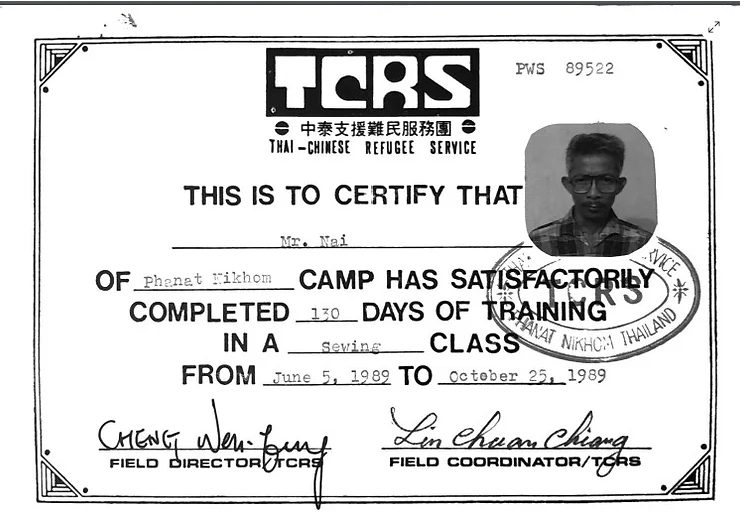
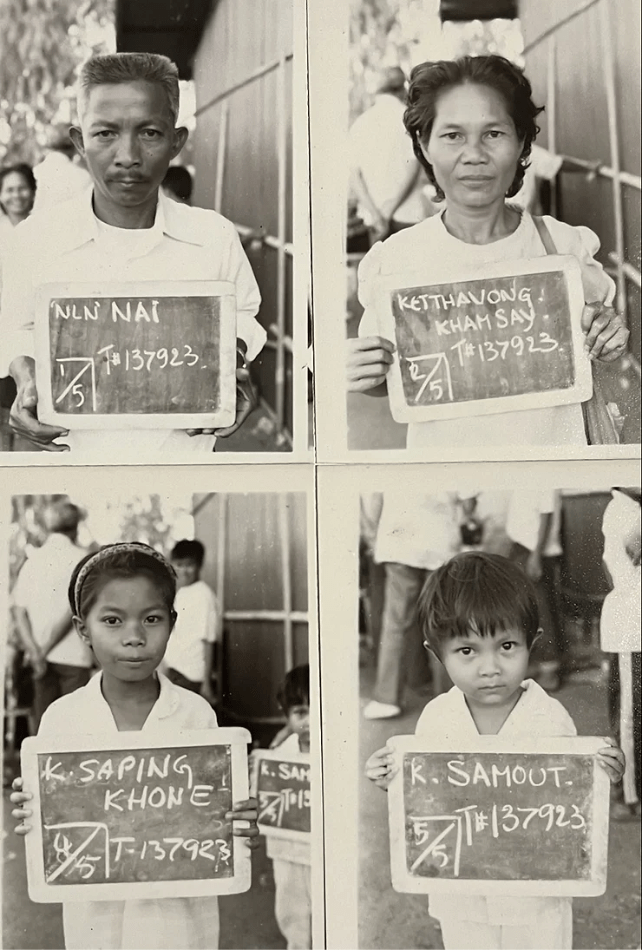
As I thumb through the official documents from the refugee camp that accompanied my family’s tickets to the United States, devastating grief overwhelms me. Grief for my family and for every family that has had to leave their lives and homes behind under such circumstances. My parents, Nai and Khamsy Kettavong, and my siblings were part of the thousands of Southeast Asians who fled the region in the second half of the 20th century due to war. I am the only person in my immediate family to have been born in the United States, but I still exist between two worlds: one here and one across oceans and the Mekong River.
“Refugees learned trade skills while in the camps in efforts to help them find work upon being placed. My dad learned to sew but I never actually saw him stitch or sew anything growing up. It was my mother who would make pillows and other things for work. You can see in the stamp that they were in Phanat Nikhom Thailand, which is partially why my brother is named Vinat. He was born there.”“Pa and fellow Lao folks in the refugee camp. He is the third from the left in the front row.”
Reviewing the paperwork that shows my father was recognized as part of the United States Special Guerrilla Unit during the Vietnam War from 1960-1975, I can’t help but feel my heart breaking. He was a sergeant. He was a prisoner of war. And he was my father. The recognition is but a small nod toward healing and repairing the immense, still immeasurable damage caused by the U.S. Secret War in Laos that left millions of tons of ordnance (two million tons during 580,000 bombing sorties, equal to a planeload of bombs every 8 minutes, 24 hours a day, for 9 years) embedded in the land. These hidden dangers and remnants of violence threaten people even decades after the war has ended.
After fleeing with the clothes on their backs and only the essentials that they could carry, my family spent a couple years in refugee camps in Thailand, and they arrived in Texas on Halloween Day in 1989 by the grace of a generous sponsor.
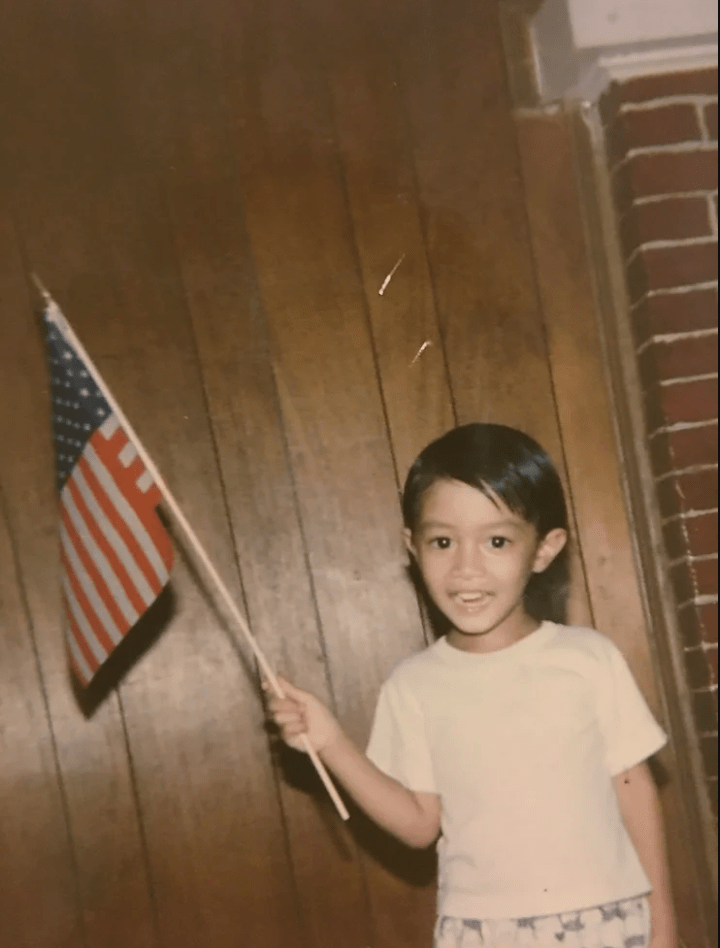
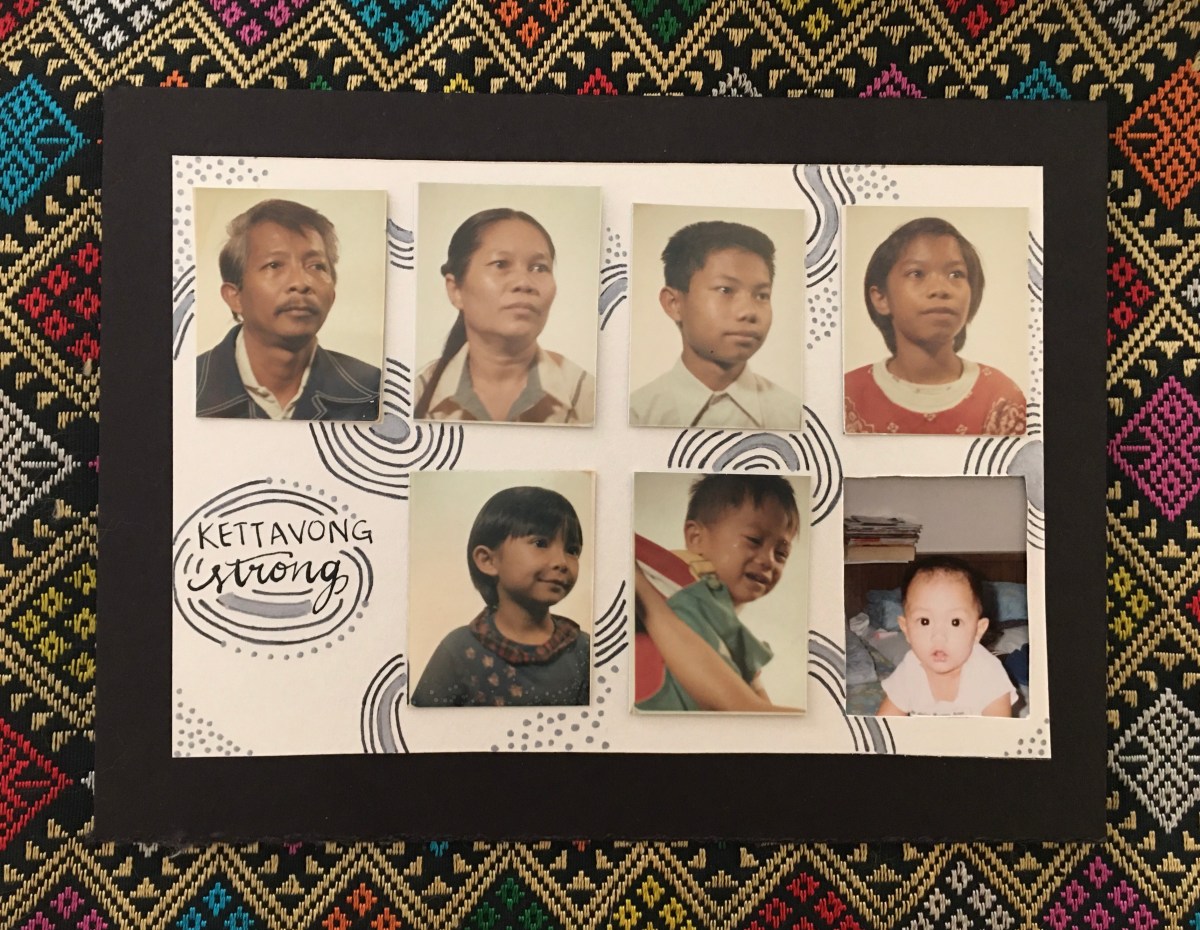
“Pa, Mae, my eldest sister Khone, and the middle child, Samout. Photos were taken in the refugee camp as part of their “processing” before leaving for the United States.”“Little Lasamee waving an American flag. I miss those zebra shorts. This photo means so much to me presently.”
Growing up, I was deeply interested in my family’s history and my motherland. Learning what little I could about Laos made me feel connected to a place where I thought I might belong. I knew that my background was different from those of the children I went to school with in Dallas, Texas, in a predominantly Hispanic neighborhood. I felt like the “other” for so many reasons. For the first decade and a half of my life, interactions with people at school were my window into what was outside of my very sheltered upbringing, but the window didn’t equal connection, just a view.
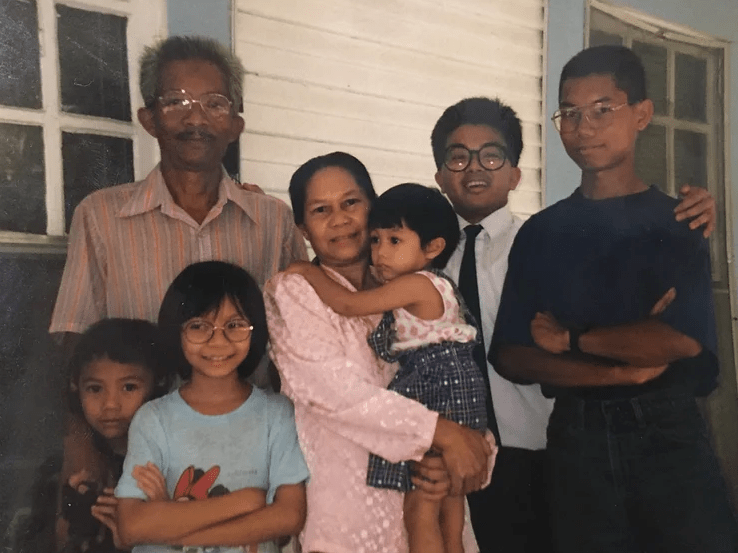
“My brother Vinat, Pa, sister Samout, Mae, me in her arms, a missionary visiting our home whose name I don’t know, and my eldest brother, Sing. My family’s history with religion here in the states is interesting. A story for another day.”
I imagine that my father wanted to keep his family safe (limiting contact and experiences), preserve Lao traditions and values (controlling our every move and avoiding assimilation as much as possible), and didn’t know how to (or perhaps, really want to) navigate the new place in which he’d landed, so he refused to become part of the community or allow his family to do so. Sometimes I think that he expected a hero’s welcome, or at least, a little more than what was provided when he made it to the states. My mother told me that on the day that they left, he tried to wear part of his uniform until a neighbor advised him against it. These are stories that I cannot confirm, as he passed away in February 2021. We would never get to reach a place of knowing and understanding one another. I would often wonder aloud in therapy sessions how to tell people about my father. My therapist helped me find the words: “My father has horrific PTSD and cannot be around people.”
“Pa and friend during a rare outing. This is my favorite photo of him. He seems genuinely happy here.”
Because of this, school was my safe space. As a child, I would check out from the library the one picture book about Laos that was on the shelves. Just the one. I would memorize facts about the Plain of Jars and close my eyes, pretending I was there. Imagining what the earth smelled like. What it felt like to stand near the river’s edge. What it would sound like to hear Lao people conversing off in the distance. I wouldn’t learn about The Secret War and the unexploded ordnance until late high school or early college. I can’t remember what news article I had come across, but I can recall feeling gutted. Angry. Frustrated that this was something I hadn’t learned about in history classes. People, my people–and children at that were still dying from a war that had already devastated the land and its people. The legacy of this war was such that lives are still lost to it and the land continues to be marred by explosives. The frustrating part is that more could have been and could be done to prevent this from happening.
In college, I wrote about the Mekong River for my philosophy of water class and briefly mentioned the UXO in relation to hydropower projects and lack of requiring environmental impact assessments. In graduate school, I pulled together a term paper about “ecocide” and how that word was coined in relation to deforestation efforts during the Vietnam War. Research and writing filled a part of my soul that desired knowledge about Laos and my heritage, but I was still disconnected from the dots that I was collecting. Not until I began to meet and work with Lao folks of my generation did I begin to move the dots where they belonged and draw lines between them.
“Lunch December 2021 with Sera, friends, and H.E. Lao Ambassador Khamphan Anlavan. at Khao Noodle Shop in Dallas”
It was during the height of the pandemic that I watched a screening of This Little Land of Mineswith Legacies of War and virtually met Sera Koulabdara, CEO and “KOUL-mander in Chief” of the organization, and Erin McGoff, director of the documentary. It was an emotional viewing, and it seemed that the experience bonded viewers and the LoW team alike. Emotional is an understatement: I think we all cried through watching the documentary. I have a habit of seeing my family in every book or documentary that has any mention of Laos in it, so this particular documentary moved me into my intergenerational trauma head space.
Bonded by tears, Sera and I became friends on Instagram and months later, I invited her to my wedding since she’d be in town that weekend. (Every Lao person I meet becomes like family very quickly.) Now, when she’s in Texas, we make it a point to try to see one another. Our little lights shine together through the darkness.
Despite the trauma and the darkness that surrounds my family history and those of families who went through similar situations, I have always felt hope for better, brighter, warmer days ahead, even if just the slightest glimmer of it comes through. Perhaps the ability for that sliver of hope to survive within me comes from the name given to me by my parents, Lasamee, which means something along the lines of “celestial light.” I am eternally grateful that Legacies of War exists to aid us in our grieving, healing, rebuilding, and empowerment.
I wasn’t always Laci, and for a while, I wasn’t Lasamee. Read more about that journey.
A few years ago, I spoke on an Asian American Pacific Islanders (AAPI) professionals panel. There were dozens of university students in attendance. It was Asian American Pacific Islander month, which made me feel as if I had a duty to the the Lao community, South East Asians, and anyone else who had had to deal with slurs or offensive questions like “Where are you from, from?” The invitation to participate in this AAPI panel had indicated that panelists were supposed to talk about our career paths and how we had found our way into that field. Easy enough, I thought. Sure, I can commit to this. I thought I’d cover my bases and read a little bit about Lao history just in case that was part of the series of questions that I expected.
In a tidy row with fellow panelists. Photo credit UNT ASA.
There I was: wearing a blazer despite the Texas heat to cover my tattoos, hair straightened and styled in what I considered an edgy asymmetrical cut, sitting next to a Vietnamese news anchor who worked in the DFW metroplex and an actor dreamboat kind of person who was a Power Ranger on the most recent version of the show. (Childhood dreams, am I right?) There was a younger Korean American student on the panel as well, representing his fellow students, who probably felt a similar pressure that I did. We had a UNT professor on the panel to round it out.
It was an hour-long session with myself and four colleagues. We were all seated in a row at the front of an auditorium-style classroom. All eyes on us. Deemed the ones who had “made it.” Worthy of speaking to the next generation. The folks who had succeeded, in theory. Students from the university curiously scrutinized each of us, or so I thought. I fashioned my usual grimace into what I thought was a pleasant expression. I sat upright. My left foot jiggling at a rate of 45 miles per hour to release the anxiety from my body.
The expected questions rolled in, and those were easy. “What did you choose to study and why?” “How hard was it to find a job after you graduated?” “How do you feel as an Asian American in the work force?” We talked about things like “how we chose our career paths” (can’t say that it was 100% chosen but more like 60% “I know how to do this” and 40% this business needs me for these certain things). And what it was like to be an AAPI American navigating the world of higher education, many of us having been first-generation students whose parents were refugees or immigrants who had not experienced the world that we were in.
UNT Asian Student Association members, panelists, and me, as Laci. Look at that good old American flag behind us. Photo credit to UNT ASA.
Two questions stand out in my memory (read: I’ve been obsessing over my responses to these questions for four years):
How do we bring together SEA students and help them identify proudly as themselves?
How do you/we reclaim our names?
The answer to the first question was easy for me. “Food.” I answered, in a serious tone but grinning. People laughed and some nodded appreciatively. Who doesn’t love food??
I elaborated and went on to say that food brings people together, that it’s how we share time and community, and that, if anything, college students were usually up for a meal.
When I lived in a college dorm, I desperately missed my mother’s Lao cooking. She always seemed to know when I’d had a hard day at school and work, and there would be a pot of soup waiting for me on the stove when I got home. If it was khao poon, all of my worries and stresses melted away at the first chew of the somen noodles and sip of hot, spicy, coconut-creamy broth.
I was thinking of those moments where I craved a steaming bowl of noodle soup or something that reminded me of the comforts of my mother’s love. I wanted a warm embrace; a feeling that one could really only achieve from eating a bowl of noodles and broth made from love and ancestral care.
And now, I own and run my own food and culture business, Good and Golden, with my partner. But that is truly a story for a different day.
To the second question, I hesitated.
I felt like I was bullshitting as a panelist on the AAPI career panel and that I was failing this poor young person. Warmth rose everywhere in my body; I was sure they could see sweat droplets falling off of my nose from 30 feet away. My response was that I gave the person asking options. I wrote my actual email on my resume that included my full name, but then typed “Laci” instead of “Lasamee” at the top to maybe try to beat an algorithm or get past the first round of eyes. Because I felt foreign and unwelcome.
But why wouldn’t my given name be front and center? The name that was thoughtfully gifted to me by my parents upon reaching earth-side from my mother’s womb. It was a name that might not have rolled off the tongue as easily for everyone as the rest of the names of the resident population based on where I was born. Read: Lao refugee immigrant child born in Texas, in the U.S. of A. named something that translated to “celestial light” and was three syllables strung together in a way that no other word in the English language was. A foreign name. An unfamiliar name. Difficult. Complex. A problem for others who didn’t have a couple of minutes to practice the pronunciation.
I knew that that answer was unsatisfactory to me and probably unsatisfactory to the students sitting the in the audience for that panel. But it was the experience that I had at the time.
How do I accommodate the world that I live in? The place that I occupy as a Lao American woman?
What ways can I weasel my way in to this professional world and try to just touch the glass ceiling (not even imagining I could break it)?
What part of my identity am I willing to dim to be able to get a foot in the door?
Why would I fight for my name when it’s so much easier to say Laci than it is to say Lasamee in this situation?
The reporter questions: who, what, when, where, why? What does it matter? To whom? I’m here now, am I not? In the states, with my family. Why would I complicate something “as simple as an introduction?”
I didn’t have a good answer for them because I hadn’t experienced what it was like to truly take back my name.
Until spring of 2021.
It was just a couple months after my father had passed. And I was particularly enraged after the shootings of Asian Americans in Atlanta, an intersection of racism and sexism manifesting in murder. I am still working on trying to figure out how I move through this world as an Asian American woman. I am still angry.
I also make up scenarios in my head in which I have to defend or protect myself or my mother. It fills me with a motivating warmth to become fitter, stronger, ready to throw someone if needed. It’s funny but it’s not. Throughout my life, there have been moments where I’ve remained silent and haven’t done anything at all when someone’s made fun of my name or sing-song chanted made-up words that are their generalized idea of what my mother tongue sounds like. At a restaurant where I was a hostess, I was once called “that oriental girl” and was too shocked to say anything (thankfully, the manager on duty told off the offender); the man who used that adjective was actually trying (and failing) to compliment me, but I’m not a rug my dude.
I could go on about my rage, but I want to take some time to thank the people who readily learned how to pronounce my name and now say it with gusto, with love, with enthusiasm.
In the spring of 2021, I posted a vague “call me by my name” social media post while sitting outside enjoying the fire in my chiminea on the porch but also wallowing in a bit of sadness. The next day, I showed up to work (hi, Heather!) and was asked how I could be supported in the reclaiming of my name, and now I realize, returning to myself. I couldn’t tell you when I lost her though. I tear up thinking about it to this day. My soon-to-be in-laws (this was only a couple months before the wedding in 2021) practiced my name over and over again, in my presence and I will assume, with one another when I wasn’t there. It’s truly music to my ears. Sometimes, I still get goosebumps when I hear my name being spoken aloud, instead of people saying “Laci” which was an adoption of convenience when I knew no better.
It wasn’t too difficult for me to take back my name in the end, and it was pretty painless, to return to being Lasamee. You can do it, kids. I want to hear from you how it goes when you return to yourself, too.
with love,
Lasamee
Me, present day, as Lasamee. Seeing myself this way truly makes me feel like I could be a Muay Thai competitor. After joking about it in relation to this photo, I finally signed up for kickboxing classes. Photo taken by the talented Marie Nuchols of Headshot Headquarters.
In hindsight, for that panel, most attendees were probably more interested in the charming Power Ranger actor guy, who, in the end, I also found charming and sweet. Later we would bond over our shared love of sambal olek, or chili garlic sauce, that we both kept stocked in our pantries. (Hey, Peter!)
February 11th marks one year of my father’s passing, and a little under one year since I’ve published a blog post. I would love to say that this was intentional, but it wasn’t. I was just dealing with a lot of shit and spending too much time away from what feeds my soul (more on that in another post that’s been fermenting).
I love the momentum of a “new year” whether it’s literally a new year or a turn around the sun (birthdays) which is why I mark significant dates as anniversaries during which we are “starting anew.”
February 11th marks one year of my father’s passing, and a little under one year since I’ve published a blog post. I would love to say that this was intentional, but it wasn’t. I was just dealing with a lot of shit and spending too much time away from what feeds my soul (more on that in another post that’s been fermenting).
When you lose someone as significant to your life as a parent, you’re transformed. This is something I found myself declaring in the early days to my therapist and anyone who would listen post-father loss. I felt a seismic shift within myself but didn’t know what that would look like. But there are some earth shattering experiences that you can’t go through without unlocking a part of yourself that needed to be let loose at some point so you can become your whole self.
So here’s my year-in-grief-review, picking moments that stood out to me and felt connected to my father-loss.
I told a friend that I felt like I could “kick doors down” and that I “wasn’t afraid of anything!” and I think it was the adrenaline from the shock of my dad’s death speaking at the time. But little things started taking shape and manifesting.
In the wake of anti-Asian sentiment and hate crimes, I took my very Asian name back o f f i c i a l l y, the one given to me by my parents: Lasamee Kettavong.
I embodied the “kick doors down” power and somehow no longer gave a fuck whether someone liked me or not. I began to let all of my colors show, wherever I went and with whomever I spoke. Life is short and the unexpected will happen (which you CAN expect, ha. ha.).
I’ve thought about what my epitaph would be and what my tombstone would look like since the time I learned what an epitaph was (probably in high school english class). My tombstone sure as hell will NOT read “Laci” because that’s not who I am. My name means something synonymous with “celestial light” and I can’t live with myself avoiding embodying that brilliance that my mother gave me, so here I am, nice and shiny (read: oily, lol) for ya.
Throwing myself into learning more about the motherland and connecting with other Lao folx has helped me feel like part of a community and that I belong and am accepted. That’s mind-blowingly heartwarming for me. For some reason, my dad didn’t really help the family become a part of the Lao community when we were younger, and that’s a shame; my mom is a social creature and extrovert.
Blake and I finally got married this past year, which we were planning on doing anyway, but … now I actually had an easy reason to tell people why my dad wasn’t present. Before, it was “My father has complex PTSD and can’t be around people” with a big, fat, loaded silence following it. “He’s dead,” is a much easier to digest and say reason, plus, no one wants to upset the bride the day of the wedding and bring up dead dad, right? (Sorry, this is my sense of humor and how I talk … dark and maybe a little blasphemous?) My sweet mama walked me down the aisle.
Me, trying not to let fat tears roll down my face during a moment of silence for the people who couldn’t be with us on our wedding day
As the day of the dead/Dia de los Muertos rolled around, I’d planned to read a letter to my dad at an open mic but ultimately that didn’t happen. It’s okay though – I wrote one to him anyway, and now it exists in the world and has helped me do some healing. My therapist was excited for me to take this major step (publicly announcing my father), but that will have to wait.
What else did I accomplish? Finishing a podcast, The Untitled Dad Project, which for me is monumental. I’ve only finished listening to one audio book in my lifetime because I can’t stay focused on longer audio pieces.
And last but not least, my partner and I started our small business, Good and Golden, which aims to share Lao food and culture (lookin’ for partners here!) with people who don’t know what or where Laos is!
And, I learned a little more about what forgiveness looks like for me.
I hope that he didn’t suffer
January 20, 2019 was the last day that I saw my father in-person at his care facility. My brother and sister went with me. We’d had brunch and mimosas. We pulled in, parked, and my brother and I shared a cigarette, while my sister climbed a nearby crepe myrtle. She gets her anxious energy out in weird ways; my brother and I have our own coping methods.
Samout, climbing a tree and being silly before seeing our dad for the first time in years
I noted the automatic sliding door, the decorated entryway, the fake plants, the office-like feel to the environment, and the front desk person greeted us, asking what we needed and who we were there to see. I was in family historian mode. “Nai Kettavong,” we said, as she searched up where he might be and on what floor. We got on an elevator.
“Oh no one ever visits Nai,” the staff person on the second floor responded. I cringed. The place didn’t feel real. It felt like a dream where you know that you’re asleep and intuitively, you know where you are and feel like you’ve been there before. This was the first time I’d ever stepped foot in this facility.
We were lead to my father’s room, and it was empty. I panicked a little inside.
“He might be watching TV in the common room,” our guide said, and we followed him, completely silent.
There he was. My dad. The man who I had feared for most of my life and felt some dutiful love towards as his daughter. He was alone. There were chairs here and there in the room and a lonely couch, a couple of small cafe-sized tables along the wall. At least there was a window, wall to wall, behind him. We pulled up a couple chairs to the round table that he was seated at, a walker nearby.
Playing on the television was some mundane show about wildlife or something that I didn’t particularly care about but was glad there was something for all of us to look at when we needed to look away from one another.
He looked so much grayer, pale, and older than I remembered. He had the same smile though, somewhat sheepish and shy. Perhaps he felt as if he were dreaming too. His children were actually there to see him. Chasms of guilt rippled through me.
“Do you remember me?” my sister asked.
“Yes,” he replied calmly.
I’d suspected that the language barrier between my father and staff contributed to my father’s diagnosis of early dementia. I would observe a little more closely, I thought to myself.
“How are you?” my brother asked. “I’m fine here. I get a little cold,” he responded.
Later, my brother would take the scarf that he was wearing and give it my dad because of the comment about being cold, which I’d notice in all of his photos in the years following. Our oldest sister would become his caretaker in Texas City, where he would be moved to in just a few months following this visit.
The conversation was slow. The three of us assessed the situation, asking questions here and there. Speaking Lao out loud to our estranged father was quite the task. And we were electrified by being in his presence again, I think.
I asked him if I could ask him some questions for a project that I was working on, and he said, “Go ahead, ask, and I’ll tell you everything.” That was the last time we spoke. I didn’t get to ask him any questions again.
Gray is how I feel when I think about this. Like hand torn paper pieces that have been mixed with water to become pulp and and then pressed, to live a different life. Lumps. Speckles. Wet. Shapeless until the next step. Amorphous and gray. Lacking any brightness, any warmth.
Recently, I realized that a confident sign that you have forgiven someone who abused and terrorized you and your family (even if it was their own family) is that you pray that they did not suffer during their last days. That hot, boiling rage that you used to feel when you cursed them into oblivion turns into just your body temperature as you sigh and think about them.
The ‘rona finally got me after two years of the pandemic, and it was days of body aches, fever dreams, sinus pressure, sneezing, coughing, and mucus. The first night, I rolled over and said to Blake, “I hope my dad didn’t suffer,” and tried to get a good cry out. It didn’t work. I finally cried typing “He was alone,” in the above paragraph.
It took another couple of days for me to think to myself, “Ah. Yes. I did the work. I have forgiven.”
My father died of COVID complications last year, and we still have not been able to take his ashes to his final resting place. For Lao folks, this is usually the temple in the community. I know that this is the case for too many at this point in the pandemic. I am so sorry.
It’s been nearly an entire year since I’ve published anything on this blog, and it somewhat symbolizes where I’ve been with my grief: in the in-between. Which, I suppose, is where we could say my father’s physical being is too.
If you are in the in-between, I will meet you where you are. If you need help, please let yourself shoot that text, make a call, send an email, or call an anonymous hotline. It’s worth it; you’re worth it.
I’ve made this spicy, funky, sour, mortar-ed and pestle-ed shredded, green papaya salad (thum makhoong) dozens of times. Sometimes if the Thai chilies and garlic that I’m crushing pops out of the mortar and gets into my eyes, I’ll cry.
This time, I’m crying because I’m remembering how my dad used to make thum makhoong for family meals: very sour, not too sweet, little bit of funk from the padaek (fermented fish sauce) and extremely spicy. Lao people eat thum something (papaya, cucumber, carrots, so on) with nearly every meal.
“Am I going to do this every time?” I ask my partner, as he gives my arm a squeeze, and I scrub at my face. It was day nine post-my father’s passing, and we were managing to stay warm and survive during the worst winter storm of my life, exacerbated by Texas’ energy grid failings (but that’s another story), and I have been moving through the days in a blur. I had consistently been able to cry while listening to “Live Forever” by Billy Joe Shaver to avoid emotional constipation. For whatever reason, the lyrics “I’m going to live forever, I’m going to cross that river” magically floated to the front of my mind on the day of his death. But other moments lately, I’m quite unsure what will bring tears to my eyes.
Mostly memories make my eyes sting but the pain is moving more toward thinking about what could have been and never was. What can now only be dreamed.
On hot summer days, when pa would water the herb and plant garden in the backyard, fragrant with spearmint and Thai basil, vibrant with giant green gourds and adorably wrinkly looking bitter melon, I’d play in the shower of the garden hose water, always hoping the sun would gift us a rainbow.
When pa smoked a cigarette after dinner, I’d bat at the plumes of smoke that he exhaled. Summer nights outside feeding june bugs to the chickens and feeling the sticky heat of the day slowly leaving.
I am comforted by the scents of mint and tobacco to this day.
I used to run into my father’s arms after pre-k and kindergarten classes. How I hated to be away from home in a foreign place those days, away from my caretaker and the family pets, and the creature comforts that a 5 year-old has, no matter how sparse they were.
Pa had a temper, but he also had tenderness for growing, living beings.
I questioned him here and there, perhaps foolishly, but when you’re young, you’re naive.
“Why do you get to watch your Lao comedy shows, but you don’t let mom watch her Thai soap operas?”
Crickets.
“Why won’t you let me participate in academic clubs and sports?”
“Why can’t we visit our friends’ houses?”
The concerns of a little girl, of course.
I never got to ask him certain questions that I was sure would help us repair our relationship, someday.
“Why won’t you tell your sons and daughters that you’re proud of them?”
“Do you love us?”
“What happened in the war?”
“Where were you born?”
“What was your relationship with your parents like?”
“Do you feel any remorse for what you did to your own flesh and blood? The woman you married?”
“What happened during the interrogation by the Thai police?”
“Would you ever want to visit Laos?”
“What do you miss about Laos?”
“What’s your favorite meal?”
The Saturday before my dad’s death, my siblings and I had a Zoom call for the first time, ever. We don’t talk much but do try to stay in touch and check in every now and then. We have a group chat but somehow managed to avoid Zoom even during the pandemic that burns slowly on.
The last time we had a call with all five of us was when my mother had a minor stroke in November 2016. Our parents somehow always bring us together even if one of them (my father) tried to drive us apart.
We arranged this Zoom call because our father had COVID. He was in a care facility in Texas City where my oldest sister lives.
He’s “okay but not great” is what the woman on the phone told me when I called to check on him. She hesitated. I felt the silence.
I asked if we could arrange a time to FaceTime.
She told me that would be “hit or miss.”
That it’s her and one other person taking care of the COVID unit. Her and Laura.
I asked for her name. Nicole.
Said “Thank you. Take care.”
Hung up.
Hours later, my sister told the family “Dad just passed away!” Time slowed down and sped up. Chaos ensued. Calls missed, FaceTimes urgently popping up, having to tell mom. Having to figure out how to breathe. Having to persevere. Having to hurt. Grieve.
Everything feels fragmented and disjointed when I try to think about the reality of what is happening right now. Like I don’t know how to use words and form sentences properly. Like I have brain fog, but I’m not the one infected.
Have I done all that I could? Probably not.
Would it be enough for me even if I did? Never.
Many things have come of this upheaval of life.
For one, I trust my cards, and I trust my intuition. The two times that I have felt a deep calling from the universe the way that I have regarding my mother’s health and my father’s death will remain distinct, incomparable, and telling.
This sense of urgency and inexplicable connection to them, to the universe, to some web of our collective unconscious, that struck me as “something profound is happening” comforts me, even if historically it has been a harbinger of bad news. In the future, should this sense overtake me again, I will know that I need to act.
I have to believe in the power of this sense and its source. Or else I can’t believe that my father knows that I forgive him, can hear me tell him that I love him, and I’m sorry. And that he loves me still, too.
My siblings and I have talked more than we ever have in the past few weeks, the five of us, as far as I can remember. We’ve shared emotions and tears that we never did when our father was alive. This has to mean something too. Thanks dad.








![year in [grief] review & forgiveness](https://notcertainbutprettysure.com/wp-content/uploads/2022/01/blakelasameewedding-104.jpg?w=1200)




 Musings